

IMF Reports Money Transfer Costs Exceeding 30-50% in Certain Markets

IMF Reports Money Transfer Costs Exceeding 30-50% in Certain Markets
Despite a decline over the years, money transfer expenses remain high, exceeding 30-50% in certain markets, as per a recent analysis by the International Monetary Fund (IMF).
Although the G20 aims to reduce money transfer costs to 3% by 2030, as of Q1 2023, specific corridors such as Turkey to Bulgaria and Tanzania to Uganda still impose fees of 34% and 52%.
Kieran Murphy, a Senior Financial Sector Expert in the IMF’s Monetary and Capital Markets Department, stated, “Charges surpass 50% for transfers from Turkey to neighboring Bulgaria… Costs are particularly elevated in sub-Saharan Africa, with Tanzanian remittances to Uganda and Kenya incurring fees exceeding 30%.”
Cost of sending $200 (in percent)
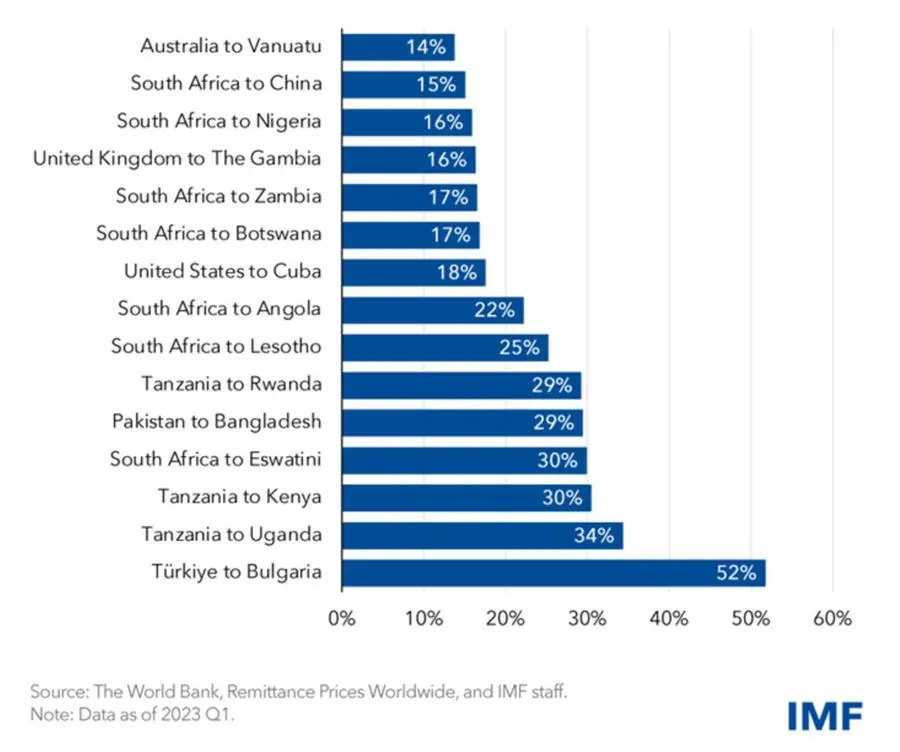
The primary factor behind high remittance costs, particularly in corridors between emerging markets and developing economies, is the imposition of fees on interbank transfers. Murphy observed that fees are considerably lower when transfers originate in advanced economies, yet foreign-exchange margins can constitute 50% or more of the overall cost in certain corridors.
To alleviate these costs, Murphy recommends that international organizations, including the IMF and the World Bank, play a pivotal role by providing technical assistance and sharing best practices with member countries.
Technical assistance is crucial because, although global targets are established, addressing specific challenges necessitates coordinated and tailored support at the country level, as highlighted by Murphy.
Looking ahead, Murphy emphasized that the IMF’s focus will be on enhancing access to payment systems, extending and aligning operating hours, interconnecting payment systems, combating money laundering and terrorism financing, and harmonizing payment systems.
In the first quarter of 2023, the worldwide average expense for sending $200 from one country to another was $12.50, or 6.25%. Although there has been a slight decrease to 6.18% in the third quarter of the year, according to the World Bank’s Remittance Prices Worldwide database.
The World Bank reported that the global average has consistently stayed below 7% since the first quarter of 2019. In essence, the current global average reflects a reduction of 3.49 percentage points since the initial quarter of 2009, when the average worldwide cost was 9.67%.
Contact us at the Consulting WP office nearest to you or submit a business inquiry online.